

Camphor
Latin Name: Cinnamomum camphora
Common Names: camphor tree, camphor laurel
Family: Lauraceae
Habitat: The locally abundant camphor tree is actually native to eastern Asia (China and Japan) and is considered invasive in North and Central Florida (UF/IFAS Invasive Assessment Status). Introduced in 1875 and planted as an ornamental and for camphor production, it has since escaped cultivation. Birds help to spread the seeds and because of this, our native Florida jujube, Ziziphus celata, an endangered species, is being outcompeted by them. While they may still be found at nurseries, they should not be purchased and planted, and instead harvested from already existing trees.
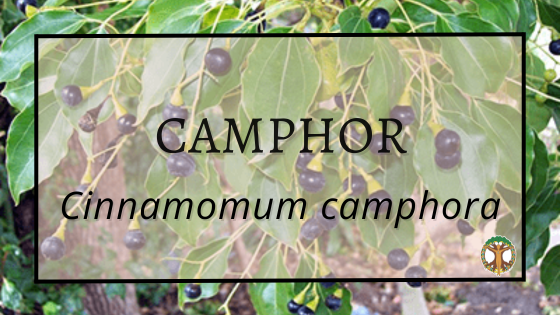
Camphor can reach heights of 40-50 ft. tall and can spread even further, 50-70ft. They are fast growing evergreens, with an alternate leaf arrangement. Leaves are ovate and simple and are shiny above and silvery underneath and when crushed smell of camphor. The small yellow flowers bloom in spring and then create a small black fruit (fleshy drupe) that is very attractive to birds. You will find them growing in full sun to part shade in a variety of soil types, though they do not tolerate water-logged soils well. They are very common in urban areas here in Central Florida and you can likely encounter them just by walking through your neighborhood.
Parts Used: leaves, stems, fruits, bark, roots
History/Tradition: Camphor has a long history of use, especially in its native range, and is still widely used today. Traditionally, it was used to clear heat, relieve pain, recover from fever, convulsions, stroke and mouth pain. It’s also helpful for inflammation like rheumatism, and used as a treatment for muscle pain relief. The Japanese used camphor to make torch flames brighter and in temples of India, camphor was used to burn incense as it was non-irritating to the eyes. Ayurvedic practices utilized camphor to help treat bronchitis, colds, diarrhea, dysentery, edema, flu and heart disease, while the Greeks used it as a head tonic and heart treatment.
Energetics: acrid, bitter, pungent, cooling
Indications: For sore muscles and aches, a salve with camphor essential oil infused into it will be really helpful, think Tiger Balm! The leaves can also be used in a steam for respiratory issues to help open sinuses and the lungs.
Systems: respiratory, musculoskeletal
Actions: anti-inflammatory, antifungal, antispasmodic, antimicrobial, antitussive, antiviral
Cautions: Only a tea made from the young roots should be taken internally, all other applications of this plant should be used externally. In large doses it is very poisonous and should be used cautiously in certain heart cases. Avoid during pregnancy. Berries are not edible.
Constituents: volatile oils (camphor, camphene, limonene, safferol and many more); the wood is steamed to collect the essential oil
Culinary Use: Green Deane says that you can make a tasty tea from the tiny root of a baby camphor tree. After you pull up the seedling, you can break the tiny root and roll it around in your hand, and it should smell of rootbeer or candy (if not, you have the wrong plant!). He also says that you can use the leaves/branches/wood to smoke food.
Other Uses: During the Black Death and smallpox outbreaks, camphor was utilized as a fumigant, and bodies were covered with rose water and camphor perfume when they were buried. It was also used as an important ingredient in perfume and embalming fluid. It’s widely used as a fragrance in cosmetics, to flavor foods, and in household cleaners. It also has strong insecticidal properties and has potential to be developed into an alternative insect repellant.
References:
https://edis.ifas.ufl.edu/publication/st167
https://edis.ifas.ufl.edu/publication/st167
https://pmc.ncbi.nlm.nih.gov/articles/PMC9102863/#sec3-molecules-27-02695
https://pmc.ncbi.nlm.nih.gov/articles/PMC6270224/
https://botanical.com/botanical/mgmh/c/campho13.html
https://www.youtube.com/watch?v=tYBoC35g6q8
https://www.eattheweeds.com/camphor-tree-cinnamons-smelly-cousin/
Written by Jaime Pawelek
One Comment
Antoninette Alexander
I love camphor. I use it for the congestion and stuffy nose. i have never used the root or leaves, because i don’t believe i live near a naturally occurring/ growing tree.I use to live in Georgia but just recently moved to coastal end of south carolina.