Loquat
Latin Name: Eriobotrya japonica
Common Names: loquat, Chinese plum, Japanese plum, misbeliefs, Japanese medlar, Pi Pa Ye
Family: Rosaceae
Habitat: Loquat is native to the cooler hill regions of southeastern and central China and has been cultivated for over 1,000 years in Japan. It has been cultivated widely around the world in subtropical regions from the southern US to South America to Australia. It was introduced into Florida before 1887 and is widely planted as an ornamental and for its fragrant flowers and delicious fruit.
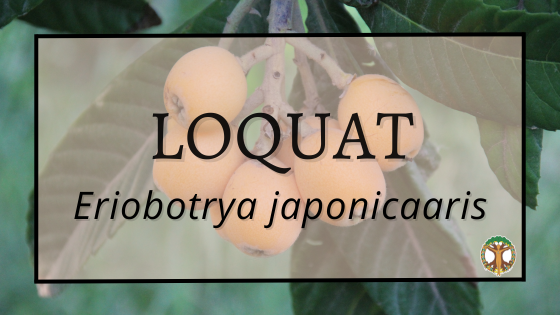
Loquat trees are evergreen and can grow up to 35 ft. tall, and they tend to have a short trunk and rounded upright canopy. The dark green leathery leaves are whorled on the branch tip and are 5-12 inches long and 3-4 inches wide. The upper surface of the leave is dark green and glossy, while the underside tends to be fuzzy. The fragrant white, 5-petaled flowers are born on a panicle with 30-100 blooms, usually in the fall or winter. The small, rounded to oblong, fruits form in clusters of 4-30 and turn yellow/orange when ripe, usually starting in Feb/March. They typically have 3-5 large seeds inside, that should not be eaten as they contain cyanogenic glycosides which release cyanide when digested. The fruit is sweet with a slight hint of acid and tastes similar to plums, peaches, and apricots, but with its own unique flavor.
Parts Used: fruit, leaf
History/Tradition: Loquat is commonly used in Chinese medicine, especially for respiratory issues when cough is associated, as well as for hyperglycemia, cancer, inflammation and fungal infections. In TCM (Traditional Chinese Medicine) loquat is associated with the lung and stomach meridians. A traditional Japanese tea is made with roasted leaves, called Biwa Cha, to support the immune system, respiratory health, blood sugar levels and skin health.
Energetics: bitter, cooling
Indications: A number of studies (see below) have looked at the different constituents within loquat leaves and have been able to demonstrate the beneficial effects that traditional Chinese medicine has been using it for. For a cough that is accompanied by phlegm, a tea made from the dried leaves of loquat are helpful for loosening and diluting the phlegm, and relieving the cough. Teas and tinctures made from loquat leaf have also shown to reduce blood sugar levels. For the digestive system, loquat leaf tea can be helpful for nausea, vomiting, belching and hiccups.
If making a tea from the leaves you have gathered yourself, be sure to wipe off the fuzzy hairs on the underside of the leaf after it has been dried as they may be irritating if not strained properly.
Systems: respiratory, digestive, integumentary
Actions: anti-inflammatory, anti-tussive, diuretic, antipyretic, antioxidant, hepatoprotective, antitumor, antibacterial, cardioprotective, hyperglycemic
Cautions: Do not consume seeds or excessive amounts of the tea
Constituents: Loquat leaf: phenolics, flavonoids, triterpenes and saponins. Fruit: sugars, organic acids, flavonoids, phenolic acids, and vitamins
Culinary Use: The delicious fruits can be eaten out of hand, dried, made into wine, pie, jam, syrup, chutney, relish, and on and on. They do not travel or keep well, which is why you don’t see them at the grocery store, but luckily, they are easy to grow here in Florida! Green Deane has a lot of recipes on his loquat profile (Eat the Weeds – see link below) and a lot of great extra info as always.
Other Uses: The pink colored hardwood has been used for a variety of products including rulers and bokken (practice sword in Japanese martial arts).
References:
https://edis.ifas.ufl.edu/publication/MG050
https://www.hort.purdue.edu/newcrop/morton/loquat.html#Other%20Uses
https://www.sciencedirect.com/topics/food-science/loquat
https://www.sciencedirect.com/science/article/abs/pii/S0305197823001242
https://www.sciencedirect.com/science/article/abs/pii/S03051978230
https://www.eattheweeds.com/loquat-getting-a-grip-on-grappa/
https://www.mdpi.com/2297-8739/10/2/126
Written by Jaime Pawelek