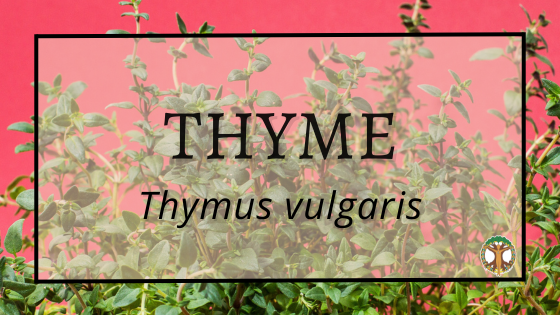
Thyme
Latin Name: Thymus vulgaris
Common Names: thyme, common thyme, German thyme, garden thyme
Family: Lamiaceae
Habitat: Native perennial to southwestern Europe and southeastern Italy, this herbaceous perennial is now commonly planted around the world. It grows well in rocky, sandy soil in full sun with good drainage. It can be grown in Florida and in my experience, summer thyme, performs well and has overwintered nicely in my garden. It can be cut back in spring to promote fresh growth. The leaves are tiny and linear, arranged in a whorl along the stem, and very fragrant. The flowers, which are white to pink, are very attractive to foraging bees.
Parts Used: leaves, which should be harvested just before flowering
History/Tradition: There are almost 400 species of thyme, many of which are also used medicinally and culinarily, as well as many cultivars including English broadleaf, French, and German winter thyme. The genus name Thymus is taken from the Greek work thymos, which means courage, or strength. The ancient Egyptians used thyme in their embalming fluid and the Greeks burned thyme in their temples and also put it in their baths. The Romans helped spread thyme throughout Europe, and used it to flavor cheeses and liqueors. Roman soldiers were also given thyme and even bathed in it to give them courage to go into battle.
Energetics: dry, bitter, warming, astringent
Indications: Helpful for treating upper respiratory tract infections, whether they are viral or bacterial in nature. Thyme is very helpful for treating a cough, as well as bronchitis, especially when there is mucus present, when drunk as a hot tea or taken as a syrup. It is also helpful for sore throats and can be used as a rinse or gargle for oral infections. It can also be used externally for infections as it is a powerful disinfectant. Its antispasmodic action makes it useful for digestive issues like gas and bloating or spasms in the digestive tract.
Systems: digestive, respiratory, nervous
Actions: antispasmodic, nervine, astringent, antiseptic, decongestant, carminative, expectorant, antitussive, bronchodilator, antimicrobial, antiviral, vermifuge, rubefacient, anti-inflammatory
Cautions: Thyme essential oil should not be used internally.
Constituents: thymol, carvacrol, tannins, flavonoids, salicylates, antioxidants, vitamins and minerals (Vitamins A, C, and B6, potassium, iron, calcium, manganese, magnesium and selenium)
Culinary Use: Most people likely have a jar of dried thyme on their spice rack and are accustomed to using it in savory dishes like pasta, eggs, soups/stews/chowders, breads, with a variety of meats and fish, as well as all kinds of vegetables like potatoes, tomatoes and mushrooms. It is commonly used in French, Creole and Cajun cuisines and found in several spice blends like herbs de Provence, za’atar, and Caribbean jerk seasoning.
References:
https://pmc.ncbi.nlm.nih.gov/articles/PMC9147557
https://plants.ces.ncsu.edu/plants/thymus-vulgaris
Making Plant Medicine by Richo Cech. 2000. Herbal Reads LLC.
Medicinal Herbs: A Beginner’s Guide by Rosemary Gladstar. 2012. Storey Publishing.
Written by Jaime Pawelek