
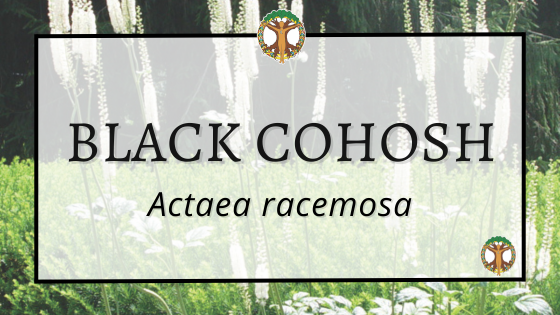
Black Cohosh
Latin Name: Actaea racemosa
Common Names: black cohosh, black snakeroot, black baneberry, cohosh bugbane, black bugbane, fairy candle, rattleweed
Family: Ranunculaceae
Habitat: Black cohosh is native to the Eastern US and the far southern parts of Ontario and Quebec, and while it makes it way down into the southern US (Alabama and Georgia) it is not native to Florida. They prefer growing in the understory of humus-rich soils in the moist eastern hardwood forests and can grow in part to full shade. Due to the high demand of this plant, loss of habitat due to logging and development, and its slow germination and growth, black cohosh is considered “At Risk” by the United Plant Savers, and is listed as endangered in both Illinois and Massachusetts.
Black cohosh is a perennial herb growing up to 8’ tall with serrated, tripinnately compound leaflets up to 3’ long and broad. In summer it blooms with hundreds of white flowers on the end of a 1-2’ raceme and has a slightly unpleasant aroma. For best flowering, they require 2-3 hours of morning sun. They are pollinated by butterflies and bees and the seeds produced require a warm-cold-warm dormancy cycle that can take anywhere from 6 months to 2 years to complete.
Parts Used: root and rhizomes
History/Tradition: Historically, Native Americans use of black cohosh ranged from gynecological to rheumatic, as well as for treating yellow fever and smallpox, and even as an antidote for rattlesnake bites.
Energetics: dry, astringent, bitter, sour, sweet, cool, relaxing
Indications: Black cohosh has wide ranging uses, but most probably know it for its benefits with reproductive health as it has an estrogen-like action. It can be helpful for those with painful menstruation, to help bring on delayed menstruation, PMS (premenstrual syndrome), and for a variety of menopausal symptoms including hot flashes, night sweats, vaginal dryness, tinnitus, sleep disturbances and irritability. Some other conditions that black cohosh may be helpful for include neurological, for instance, in the treatment of headaches, vertigo, and migraines. Its antispasmodic action has benefits for muscular issues like rheumatoid arthritis, osteoarthritis, joint pain and other inflammatory conditions. Black cohosh also has use with respiratory conditions like asthma or whooping cough.
Systems: reproductive, musculoskeletal, respiratory, nervous
Actions: amphoteric, anti-inflammatory, antirheumatic, antispasmodic, emmenagogue, nervine, uterine tonic, analgesic, anti-arrhythmic, antidepressant, antivenemous, emmenagogue, hypotensive
Cautions: Do not use during pregnancy or while nursing. Also avoid if you have any type of heart condition. Excessive use may cause nausea, vomiting, headache and lower blood pressure.
Constituents: cimicifugin, triterpene glycosides (actein, cimigoside, macrotin, racemoside), isoflavones (fomononetin), tannins, salicylic acid, mucilage and starch.
Other Uses: One of its common names, bugbane, comes from its strong fragrance, which was thought to act as a bug repellent.
References:
https://www.herbalreality.com/herb/black-cohosh/?cookie-consent-set=true
https://www.henriettes-herb.com/articles/cohosh.html
https://unitedplantsavers.org/black-cohosh-actaea-racemosa/
https://plants.ces.ncsu.edu/plants/actaea-racemosa/
https://goldenpoppyherbs.com/black-cohosh-materia-medica/
“The Modern Herbal Dispensatory: A Medicine-Making Guide” by Thomas Easley and Steven Horne. 2016. North Atlantic Books, Berkeley, CA.
“Herbal Recipes for Vibrant Health” by Rosemary Gladstar. 2001. Storey Publishing.
Written by Jaime Pawelek.